The UN backs Africa's campaign to 'Correct the Map'
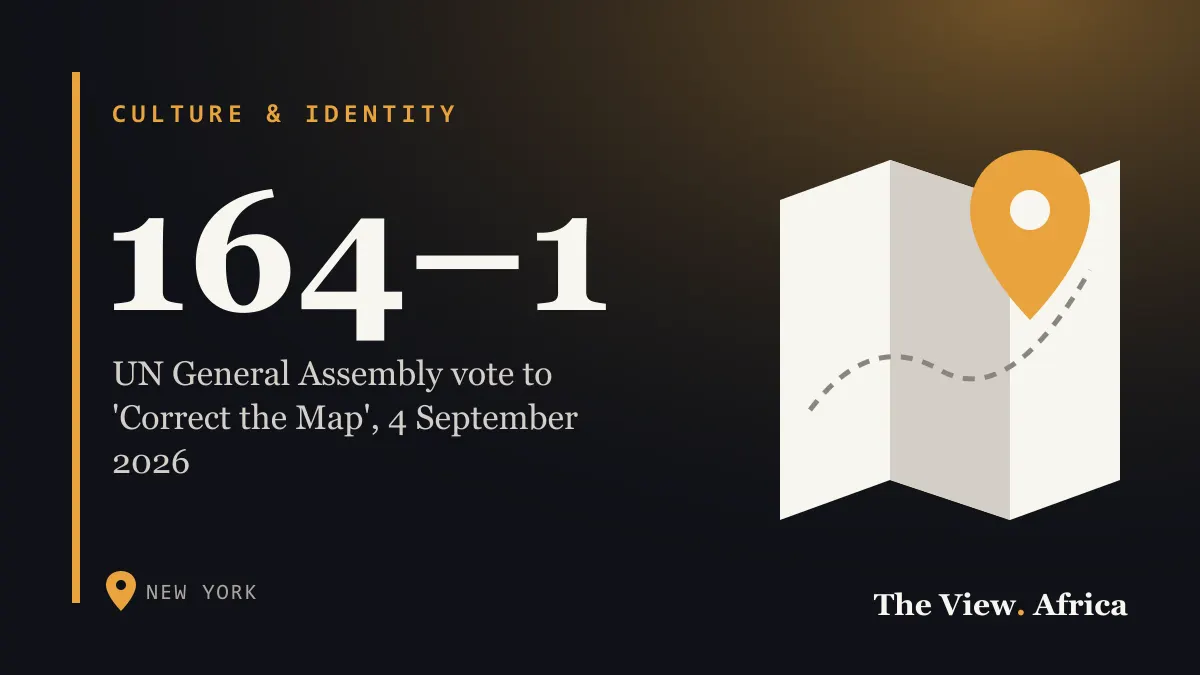
By 164 votes to one, the General Assembly urged the world to use maps that show Africa at its true size.
Key points
- On 4 September 2026 the UN General Assembly adopted the 'Correct the Map' resolution by 164 votes to one, with six abstentions; the United States voted against.
- Led by Togo and the African Union, the non-binding resolution encourages the Equal Earth or other equal-area projections where relative size matters, while keeping Mercator for navigation.
- On Mercator maps Greenland looks about as big as Africa, although Africa is roughly 14 times larger.
The United Nations General Assembly has backed an African-led campaign to show Africa at its true size on world maps. On 4 September 2026, member states adopted the "Correct the Map" resolution by 164 votes to one, with six abstentions.
The resolution was led by Togo and the African Union. It was co-sponsored by African Union member states, the Bahamas and France, according to Al Jazeera. The United States cast the only vote against, calling the resolution an ideological agenda that distracts from more substantive issues.
The problem with Mercator
Most maps people see in classrooms, newsrooms and apps use the Mercator projection, designed in the 16th century for sea navigation. It keeps directions accurate but stretches land the further it is from the equator.
The result is that Africa looks far smaller than it is. On a Mercator map, Greenland appears roughly the same size as Africa, although Africa is about 14 times larger.
What the resolution does
The resolution is non-binding. It does not ban the Mercator projection, which remains in use for maritime and air navigation.
Instead, it encourages governments, schools, international organisations, the media and technology companies to use the Equal Earth projection, or other equal-area maps, whenever the relative size of countries and continents matters.
"A fair world begins with a fair map," said Togo's Foreign Minister Robert Dussey.
From campaign to UN vote
The campaign was started by the organisations Africa No Filter and Speak Up Africa, and was endorsed by the African Union before being taken to the UN General Assembly.
Africa No Filter says the harder work starts now: getting accurate maps into schools, newsrooms and technology platforms.
Sources
Spotted an error? Read our corrections policy or tell us.