Why Zambia's election matters far beyond Zambia
Copper, debt and global competition have made the vote strategically important.

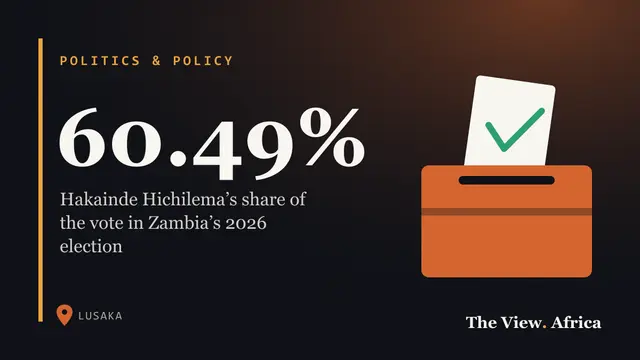
Update: Hakainde Hichilema won re-election with 60.49% of the vote on 13 August 2026. Read the latest.
Key points
- Zambia's presidential election will shape the direction of one of the world's most important copper-producing countries.
- Copper's role in electricity networks, electric vehicles and renewable energy has placed Zambia at the centre of Chinese and US competition for critical minerals.
- The next government must balance recovery from a major debt crisis and restructuring with public expectations and attracting mining investment.
Zambia's presidential election is being watched closely far beyond the country's borders.
At stake is not only the political future of one of Southern Africa's major economies, but also the direction of one of the world's most important copper-producing countries.
A country built around copper
Copper sits at the centre of Zambia's economy.
The metal is increasingly important to the global energy transition because it is used in electricity networks, electric vehicles, renewable energy systems and electronics.
That gives Zambia an importance that extends far beyond its population and economic size.
Why China and the US are watching
Zambia's mineral wealth has placed it within a broader competition over access to critical minerals.
China has long been deeply involved in African mining and infrastructure, while the United States and its partners are increasingly interested in building alternative mineral supply chains.
Zambia therefore finds itself with more leverage than it may have had in previous decades.
The economic question
The election also comes after Zambia experienced a major debt crisis and restructuring process.
The next government will have to balance economic recovery, public expectations and the need to attract investment into mining and other sectors.
More than an election
Zambia's story reflects a wider African challenge.
The continent possesses many of the minerals the global economy needs, but the question is whether African countries can capture more value from those resources rather than simply exporting raw materials.
For Zambia, the next political chapter could determine how much of its mineral wealth becomes a foundation for long-term development.
Spotted an error? Read our corrections policy or tell us.