The African project that could change a continent
A planned 700,000-barrel-a-day refinery in Lamu could reshape how East Africa gets its fuel.

Update: Construction was formally launched on 30 September 2026, while a court has frozen work on disputed land until 14 October. Read the latest.
Key points
- Aliko Dangote plans a refinery in Lamu, on Kenya's northern coast, designed to process up to 700,000 barrels of crude oil a day at an estimated cost of about $16 billion.
- Dangote says construction could begin as early as October 2026 and take less than four years, using a 30% equity and 70% debt financing structure.
- The site connects to the LAPSSET Corridor, positioning the refinery to supply markets including Uganda, Tanzania and South Sudan.
Africa's richest man, Aliko Dangote, is preparing to build one of the continent's most ambitious industrial projects yet.
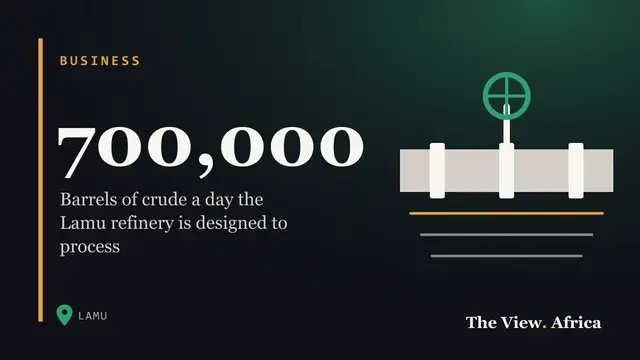
The proposed refinery in Lamu, on Kenya's northern coast, is expected to process up to 700,000 barrels of crude oil every day and supply petroleum products not just to Kenya, but to markets across East Africa.
Dangote says construction could begin as early as October 2026 and take less than four years.
If the project reaches completion, its impact could extend far beyond the refinery itself, changing fuel supply, trade, transport and industrial investment across one of Africa's fastest-growing regions.
A region that imports its fuel
East Africa has a paradox.
The region has significant oil resources, including crude reserves in countries such as Uganda, South Sudan and Kenya. Yet countries across the region remain heavily dependent on imported refined petroleum products.
Kenya's own energy policy notes that the country relies entirely on imports for its petroleum products.
That dependence leaves the region vulnerable to disruptions far beyond its borders.
When international shipping routes are disrupted or crude prices rise, the effects can quickly reach African consumers through higher transport and energy costs.
For businesses, that can mean more expensive logistics. For households, it can mean higher prices for goods transported by road. For governments, it creates another layer of pressure on already expensive fuel import bills.
Dangote's argument is simple: Africa should process more of its own resources instead of exporting crude and buying back finished products.
The proposed Lamu refinery is an attempt to put that idea into practice.
Why Lamu?
The project has gone through months of uncertainty over where it would be built.
Mombasa was previously discussed as a preferred Kenyan location, while Tanzania's Tanga was also considered as part of a wider East African refining strategy.
The project has now moved toward Lamu.
The location offers something strategically important: a deep-water port and a connection to the LAPSSET Corridor, the infrastructure network designed to connect Kenya's coast with inland markets including South Sudan and Ethiopia.
That geography could make the refinery more than a Kenyan facility.
It could become a regional distribution point for petroleum products moving north and west through East Africa.
The scale is enormous
The proposed refinery is expected to process 700,000 barrels of crude oil per day.
For comparison, Dangote's existing refinery near Lagos currently operates at around 650,000 barrels per day, making it one of the largest single-site refineries in the world.
The Kenyan project is intended to draw on lessons learned from building that facility.
Dangote has said the Lamu refinery's estimated cost has been reduced from about $17 billion to approximately $16 billion, partly because his company now has experience constructing and financing a refinery on this scale.
That would make the project one of the largest private industrial investments ever proposed in Kenya.
But the numbers only tell part of the story.
The real significance is what could happen around the refinery.
More than a refinery
Large industrial projects rarely remain isolated.
A refinery requires engineers, construction companies, logistics operators, storage facilities, pipelines, ports, maintenance services and thousands of workers.
It can also create demand for businesses that have little to do with refining itself, from accommodation and food services to transport, manufacturing and professional services.
Kenyan officials have argued that the project could create substantial employment across construction and operations.
And Lamu could gain a new economic role.
The port is already part of Kenya's long-term plan to create a second major gateway to international trade. A large refinery would add another major industrial activity to that emerging coastal corridor.
Instead of simply being a place through which goods pass, Lamu could become a place where energy is processed, stored and distributed.
A regional energy hub
Dangote's ambition goes beyond Kenya.
The proposed refinery is intended to serve the wider East African market, with countries including Uganda, Tanzania and South Sudan among the potential markets.
That matters because East Africa's economies are deeply connected.
Trucks move goods across borders. Manufacturers depend on reliable energy. Airlines require aviation fuel. Farmers need fuel for machinery and transport. Almost every part of the regional economy is connected, directly or indirectly, to petroleum products.
A large refinery located close to the coast could therefore change the movement of fuel across the region.
Instead of importing finished products from distant international markets, some countries could source them from a refinery much closer to home.
The potential result is a shorter regional supply chain, although the actual effect on pump prices will depend on crude costs, taxes, transport, financing and market competition.
The bigger African idea
The Lamu project is part of a much larger argument about Africa's industrial future.
For decades, many African economies have exported raw materials while importing finished products.
Oil is one of the clearest examples.
Countries can produce or control crude resources, yet still import petrol, diesel and aviation fuel after the crude has been processed elsewhere.
Dangote's refinery strategy challenges that model.
His Lagos refinery has already demonstrated what a large privately funded African industrial project can look like. The company is now seeking to expand its Lagos facility to as much as 1.4 million barrels per day while pursuing further investment across the continent.
The proposed Kenyan refinery takes that philosophy into another region.
The ambition is not simply to build a refinery.
It is to build industrial capacity in Africa, for African markets.
But the project still has hurdles
The scale of the opportunity comes with equally large risks.
A $16 billion refinery requires enormous financing, infrastructure and long-term policy certainty.
Dangote has said the project is expected to use a 30% equity and 70% debt financing structure. That means securing lenders for the majority of the project's cost will be critical.
There are also environmental, regulatory and logistical questions that accompany any project of this scale.
And construction has not yet begun.
The October groundbreaking is an announced target, not the completion of the project. The refinery will still need to move through financing, engineering, construction and commissioning before it can begin supplying fuel.
That distinction matters.
The project could become transformative, but its eventual impact will depend on whether the ambitious plans translate into a functioning refinery.
A different kind of African investment
If it succeeds, the Lamu refinery could represent something larger than an energy project.
It could become a symbol of Africa's growing ability to finance, build and operate large industrial infrastructure for its own markets.
Kenya would gain a major refining facility.
East Africa could gain a new source of petroleum products.
Lamu could become an important energy and logistics centre.
And Dangote would extend a business model that has already reshaped Nigeria's petroleum industry into another part of the continent.
The most important question, therefore, may not be whether Kenya needs another refinery.
It is whether Africa can build enough of its own industrial capacity to stop depending so heavily on the rest of the world.
By October, that ambition could begin moving from plans on paper to construction on the ground.
If the refinery is completed on schedule, its first barrels could mark the beginning of a very different energy story for East Africa.
Spotted an error? Read our corrections policy or tell us.