Tullow Oil turns cash-positive for the first time since 2021
Strong output in Ghana and high oil prices helped the debt-laden producer more than double its cash flow forecast.
Key points
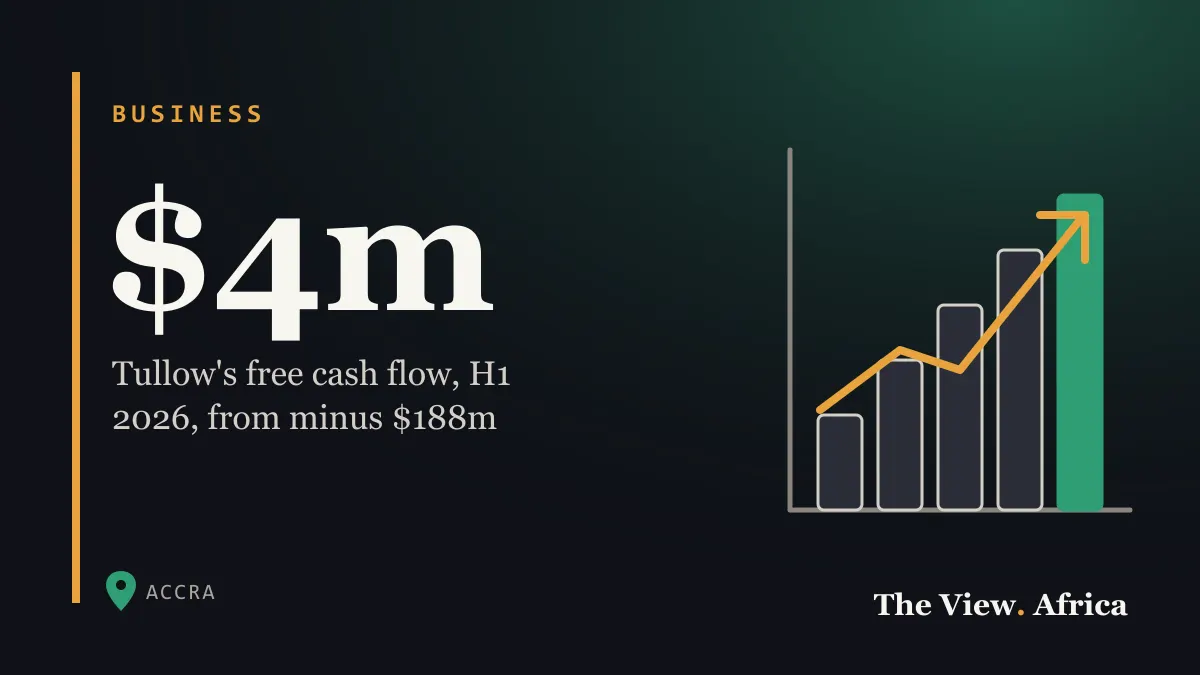
- Tullow Oil made $4 million of free cash flow in the first half of 2026, against an outflow of $188 million a year earlier, its first positive first half since 2021.
- Production rose 7% to 43,700 barrels of oil equivalent a day, and net debt fell to $1.4 billion.
- Tullow raised its full-year free cash flow forecast to $170 million to $250 million and recovered $73 million in gas payments from Ghana.
Tullow Oil, the London-listed company that runs Ghana's biggest offshore oilfields, made positive free cash flow in the first half of 2026 for the first time since 2021. It reported its results on 28 September 2026.
The numbers
- Free cash flow: $4 million, against an outflow of $188 million a year earlier.
- Revenue: $496 million, up from $411 million.
- Production: 43,700 barrels of oil equivalent a day, up 7%.
- Net debt: $1.4 billion, down from $1.6 billion.
- Oil price: $95 a barrel before hedging, up from about $71.
- Reserves replacement: more than 380%, meaning it added almost four barrels of reserves for every barrel it produced.
What changed
Tullow finished a drilling campaign at Ghana's Jubilee field, bringing six new production wells and one water injection well online. The floating production vessels at the Jubilee and TEN fields ran more than 99% of the time. The company also recovered $73 million in overdue gas payments from Ghana's government, and completed its exit from Kenya.
"We have delivered outstanding operational performance in the first half of 2026," said Chief Executive Ian Perks. He said production should come in at the top end of guidance.
Tullow more than doubled its full-year free cash flow forecast, to $170 million to $250 million, from $70 million to $175 million.
Why it matters
Tullow has spent years weighed down by debt and falling output. The company matters to Ghana, where the Jubilee and TEN fields are a big source of oil revenue. Debt is still high, and the shares fell slightly after the results, a sign that investors want to see the recovery last.
Sources
Spotted an error? Read our corrections policy or tell us.