Two fossil finds in Morocco and Ethiopia deepen the story of human origins
Jaws from Casablanca, 773,000 years old, sit near the root of our species; a jaw from Afar shows “Nutcracker Man” ranged far wider than thought.
Key points
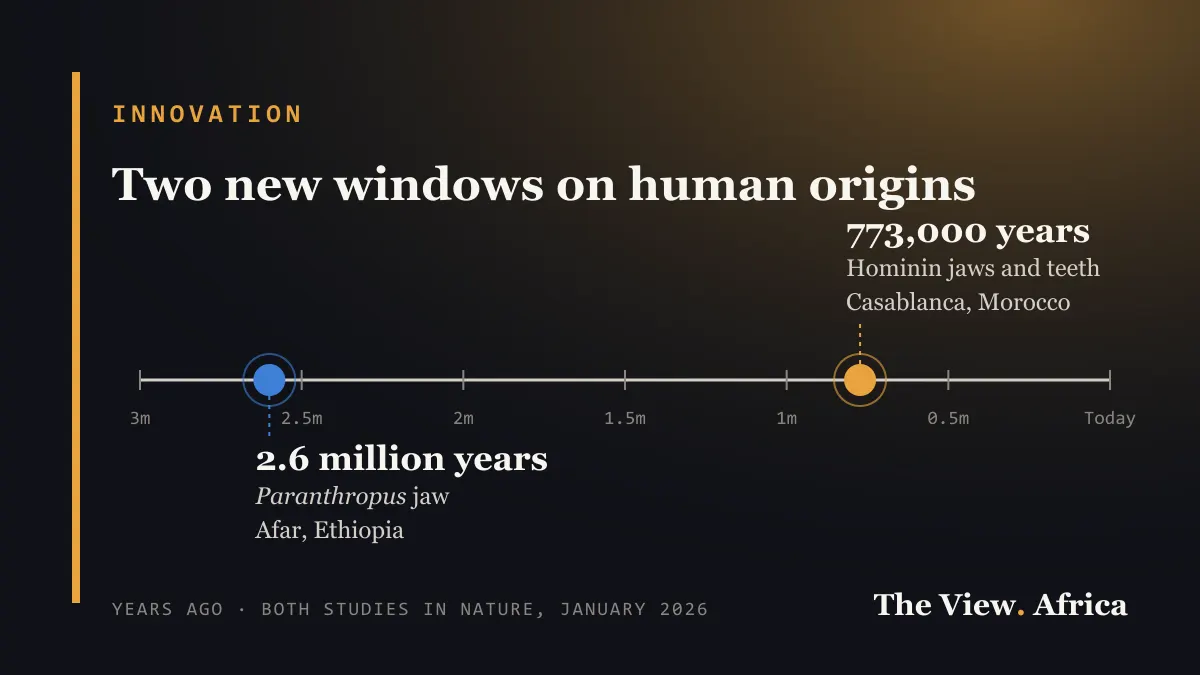
- Hominin fossils from Thomas Quarry I in Casablanca, dated to 773,000 years ago, point to an African lineage near the root of Homo sapiens, according to a study published in Nature on 7 January 2026.
- A separate Nature study described a 2.6-million-year-old Paranthropus jaw from the Mille-Logya area of Ethiopia’s Afar region, about 1,000km further north than any earlier find of the genus.
- Both studies involved African researchers and institutions, including Morocco’s national archaeology institute, INSAP.
Two discoveries published in the journal Nature in January 2026 add new chapters to Africa's place as the cradle of humankind.
Casablanca: close to the root of our species
Fossils from a cave at Thomas Quarry I in Casablanca, Morocco, have been dated to 773,000 years ago, give or take about 4,000 years. The date is unusually precise because the sediments record a known reversal of the Earth's magnetic field.
The remains include partial lower jaws, teeth and vertebrae. They mix older features seen in Homo erectus with more advanced traits, and the researchers say they represent an African lineage near the base of the one that eventually gave rise to Homo sapiens. That is strong evidence that the deep ancestry of modern humans lies in Africa rather than Eurasia.
The study, published on 7 January 2026, was led by Jean-Jacques Hublin of the Collège de France and the Max Planck Institute for Evolutionary Anthropology, with Abderrahim Mohib of Morocco's Institut National des Sciences de l'Archéologie et du Patrimoine (INSAP) among the leaders. One of the jaws was found in 2008 by quarry workers Abdellali Khadouma and Khalid Nader.
Afar: "Nutcracker Man" travelled further
In Ethiopia, a team led by Ethiopian palaeoanthropologist Zeresenay Alemseged of the University of Chicago found a 2.6-million-year-old lower jaw of Paranthropus, the robust-jawed hominin nicknamed "Nutcracker Man", at Mille-Logya in the Afar region.
It is one of the earliest known Paranthropus fossils and was found about 1,000 kilometres further north than any before it. That suggests the group was more widespread and adaptable than scientists had thought.
Why it matters
Africa's fossil record remains central to understanding where we come from, and African scientists and institutions are increasingly leading that work. Discoveries like these also draw research, tourism and attention to heritage sites, as with the finds at Egypt's Dakhla Oasis.
Sources
- Max Planck Institute for Evolutionary Anthropology: Early hominins from Thomas Quarry I
- Nature: Of all the quarries – Casablanca fossils reveal African ancestors of Homo sapiens
- Natural History Museum: Nutcracker Man ventured further and wider than previously thought
- Nature: Afar fossil shows broad distribution and versatility of Paranthropus
Spotted an error? Read our corrections policy or tell us.