A Kenyan startup's robotic hands sign for deaf pupils
ZeroBionic is also building a database of African sign languages, which AI models have largely ignored.
Key points
- Kenyan startup ZeroBionic, co-founded by 22-year-old Norah Kimathi, has built robotic hands that translate a teacher's speech into sign language in real time.
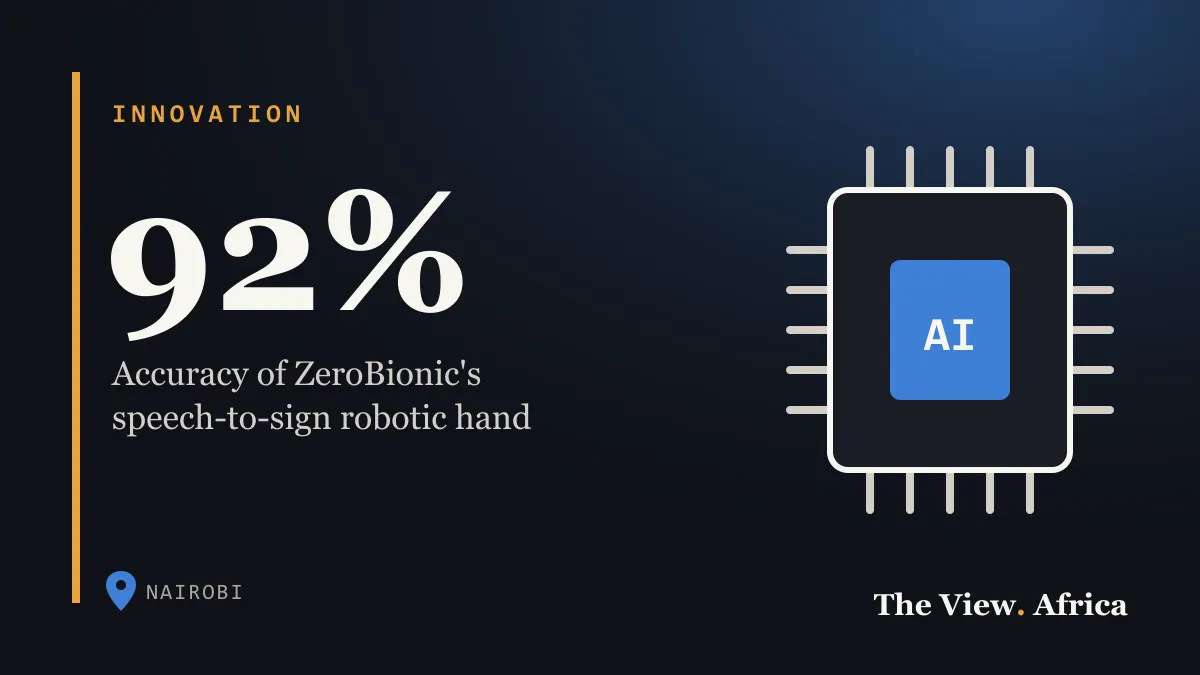
- The hands cost about $350, work offline, translate with about 92% accuracy and are in use or on trial in 78 Kenyan schools.
- Deaf teachers in motion-capture suits are building a database of African sign languages, which most AI models do not cover.
A Kenyan startup has built robotic hands that turn a teacher's speech into sign language in real time. To train them, it is building something Africa has lacked: a database of African sign languages.
ZeroBionic was co-founded in 2023 by Norah Kimathi, 22, who finished a computer science degree at Strathmore University in July 2026.
How it works
- An AI engine processes the teacher's speech, and a multi-jointed robotic hand signs the translation.
- It works offline, for schools with poor internet.
- Parts are 3D-printed in-house from recycled plastic. Each hand costs about $350 and lasts up to two years.
- It translates with about 92% accuracy and is being used or trialled in 78 Kenyan schools, including Kasarani Treeside Secondary School for the Deaf in Nairobi.
The database
Most sign-language AI is trained on Western data, mainly American Sign Language. Kenyan Sign Language is different, and so are the sign languages of Tanzania, South Africa and other countries. "No one else had built this on the continent. We had to start from scratch," Kimathi said.
Deaf teachers wear motion-capture bodysuits to record signs. That is building a database of technical terms in English, American Sign Language and Kenyan Sign Language. Other African efforts are growing too, including a 10,000-video Ghanaian Sign Language dataset for healthcare published in April 2026.
Why it matters
Kenya has about 300,000 deaf children, but only about 20,000 were in school as of 2024, and trained interpreters are scarce. A cheap device that lets deaf pupils follow lessons alongside hearing classmates could change that. The dataset could matter even more, because it gives other developers African sign-language data to build on.
Sources
- The Business Standard/AFP: Kenyan start-up makes robotic limbs to help deaf kids sign
- The Japan Times: Kenyan startup makes robotic limbs to sign for deaf kids
- iAfrica: AI powers Kenyan robot interpreter for African sign languages
- Scientific Reports: A large-scale multimodal dataset for healthcare-domain Ghanaian Sign Language
Spotted an error? Read our corrections policy or tell us.