South Africa’s giant SKA telescope “comes alive”
Two of the SKA-Mid dishes in the Northern Cape worked together for the first time, a key step for one of the world’s biggest science projects.
Key points
- The SKA-Mid telescope in South Africa’s Northern Cape achieved “first fringes” on 7 January 2026, combining signals from two of its dishes to work as an interferometer for the first time.
- The two dishes observed a radio galaxy about 2.6 billion light-years away.
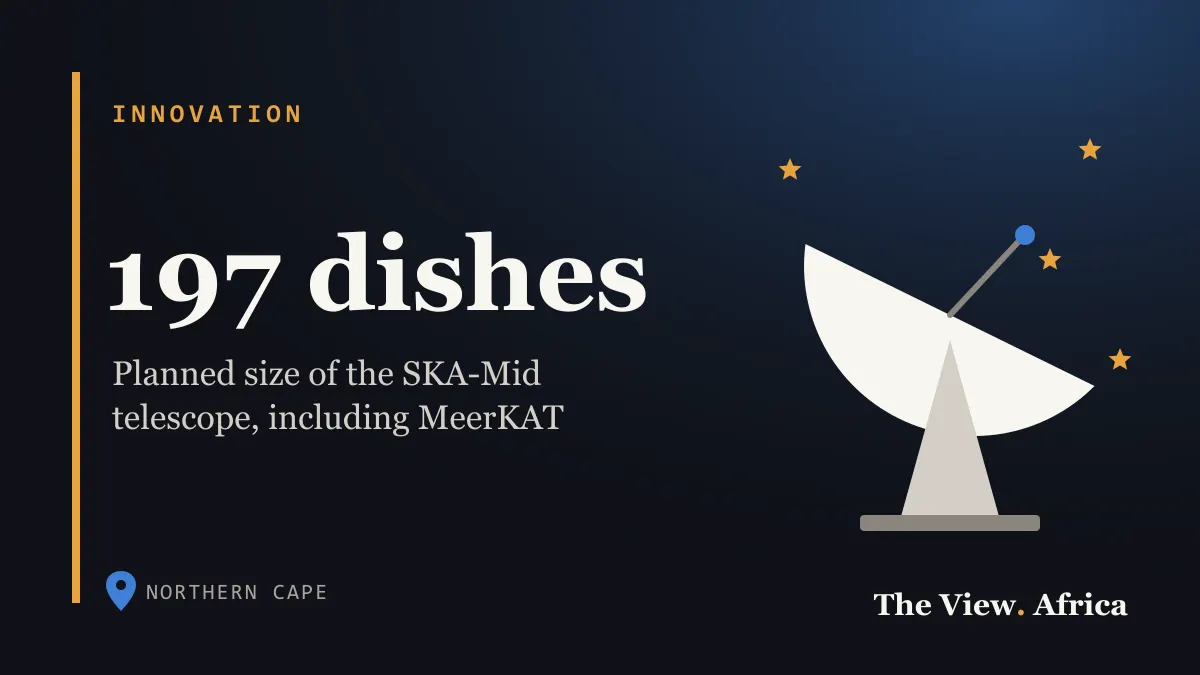
- When complete, SKA-Mid will have 197 dishes, including the 64 dishes of South Africa’s existing MeerKAT telescope.
One of the world's biggest science projects passed a milestone in South Africa this year. On 7 January 2026, the SKA-Mid radio telescope in the Northern Cape achieved "first fringes": two of its dishes combined their signals and worked together as a single instrument for the first time.
"This is the first true test that all our systems are working together, and that the SKA-Mid telescope is alive," said Professor Philip Diamond, Director-General of the SKA Observatory.
What they saw
The two dishes observed a radio galaxy about 2.6 billion light-years away, chosen because its signal is well understood, which makes it a good test. The achievement shows that the telescope's tracking, super-cooled receivers, precise timing and data processing all work together.
The Square Kilometre Array
The SKA is being built in two places: SKA-Mid, a dish array in South Africa's Karoo, and SKA-Low, an array of antennas in Western Australia. When complete, SKA-Mid will have 197 dishes, including the 64 dishes of MeerKAT, the telescope built and operated by the South African Radio Astronomy Observatory (SARAO).
Seven SKA-Mid dishes had been assembled on site at the time of the milestone, with more on the way. The next step is an image from a four-dish array.
Why it matters
The SKA will help scientists study the early universe, how galaxies form and the nature of gravity. Hosting it has already built a generation of African engineers and astronomers, and puts South Africa at the centre of global science. Africa's space ambitions are growing too, from Senegal's satellites to new national space programmes.
Sources
Spotted an error? Read our corrections policy or tell us.